

It’s fair to say that most leaders I meet genuinely care about their impact. That’s most, not all.
They typically want their teams to feel trusted and they want the high standards without burning people out. They want everything that Maslow described and to be the leader of that environment and experience for people.
However, in my experience the impact they’re having doesn’t always match the intent they have. This could be a small offset or a huge offset.
This isn’t because they’re dishonest or that they don’t have values. It’s quite the opposite. What they see as their espoused values, when held up against observed behaviours doesn’t seem to match up.
One reason that seems to hold true above most is that when you’re busy, under pressure, or trying to keep all of those plates spinning, espoused doesn’t often mean lived. You get experienced through your patterns and those can show up different values, sometimes those you really don’t like the idea of.
A couple of reflective questions for you:
If your team described your impact in one sentence, what do you hope they’d say?
If they described it on a tough week, what might they say then?
Under pressure, your beliefs surface
If I ask someone what they care about most, they tend to have a good idea.
The challenge is that when the pressure rises, this can effectively go out of the window. I like to think of this as a belief (or set of) that’s been sitting quietly in the background.
It could sound like one of these (from my own experience):
- “If I don’t step in and show them, this won’t be good enough.”
- “If I challenge that, I’ll lose the relationship and everything I’ve built.”
- “If I don’t keep everyone happy, I’ll lose people.”
And those beliefs are aligned to certain values. Not necessarily the ones you’d proudly write down, although they could be.
So even if you genuinely value empowerment, the belief “it’s up to me” can pull you towards more control.
Even if you value openness, the belief “we haven’t got time for this” can pull you towards efficiency (this is a common one).
Even if you value development, the belief “we can’t afford mistakes” can pull you towards rescuing and doing it for them.
This is what I would term the values gap. I guess this isn’t just about leadership, it could be how you show up at home, or anywhere for that matter. My time coaching girls football stood on the touchline springs to mind. At times, there were definitely gaps.
For clarity, this is not because your values aren’t real, but because in the moments that matter, your protective beliefs start reinforcing a different value.
And over time, people don’t experience your core values, that you wish to stand for. They experience what reliably shows up when the pressure is on.
A couple more questions for you:
- When things get pressured, what belief tends to show up first for you?
- What “unhelpful value” does that belief pull you towards?
Values are essentially priorities under pressure
When people talk about values, it can quickly become a bit intangible. Lots of lovely words but with abstract meanings. After all, the same word would be described differently in its impact for 2 different people.
I think it’s helpful to have a definition for what we mean by ‘values’. This is one I was introduced to a while ago and stuck with me….
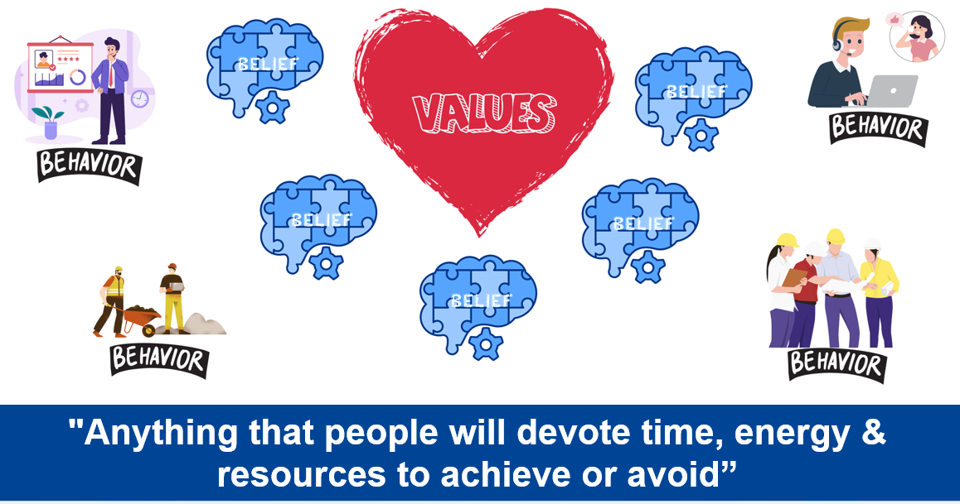
You can think of leadership as a set of trade-offs, that go on throughout the day. Examples of these that I see all the time could be:
Speed vs quality.
Autonomy vs consistency.
Harmony vs honesty.
Your values show up in which side of the trade-off you lean towards, bolstered by the beliefs that surround it and most importantly the behaviours that you then do as a result of these. This is what is experienced and the impact you have.
I can remember working with someone that talked about quality all day long. It’s all about quality Jason. I even got asked to do a piece of work to improve the quality in the work. When I found them leading a call every morning asking how much work had been completed yesterday I found it strange that they couldn’t see that this wasn’t them asking for quality, they were championing speed. They were under pressure to get the results the system required and so they de prioritised the thing they said was most important.
You may argue that they had not choice as they were reverting to the measure. If I told you they were the Director and they created the measure (and could change it), would you think the same.
And 2 more questions for you:
- Under pressure, what do you protect first – pace, certainty, standards, relationships, reputation?
- Which value do you talk about a lot… but your diary doesn’t seem to support?
Leaders should learn about his this works for them
I want to draw your thinking towards this idea of reinforcement. If values are the “why”, reinforcement is the “how”. Because people learn what matters around you by watching what you reward, tolerate, challenge and resource.
You are shaping the environment with how you act on these areas. Literally all of the time and often without you noticing. For example…
If you consistently praise responsiveness, you’ll probably get busyness.
If you consistently rescue, you’ll get dependency.
If you tolerate poor preparation, you’ll get more of it.
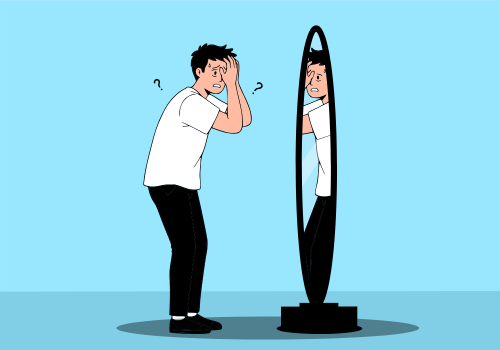
At Get Knowledge, we often use tools like the Barrett Values Leadership Assessment with clients to help make these patterns visible, discussable and then actionable. Not because leaders don’t know their values (although there is sometimes low awareness of these), but because most of us need a mirror for what we’re actually reinforcing day to day. I know I definitely do.
The Leadership assessment we use is great at providing a ‘big mirror’ on all of this, which accelerates progress and impact, but you don’t need a full assessment to start work on this. You just need to start looking, noticing and wanting to actually upgrade your leadership impact.
Final reflection…
- What do you tend to reward most – speed, certainty, loyalty, challenge, learning, polish, ownership?
- What are you currently tolerating that you’re quietly paying for?