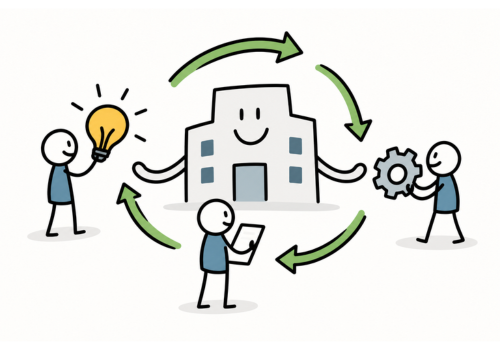
Earlier this month I attended a Simply Brilliance Brainiacs session where Eglė Vinauskaitė was talking about AI and the future of Learning and Development (L&D).
It was an interesting session and one that has stayed with me, although perhaps not for quite the reasons I’d expected.
Eglė was sharing research she’d undertaken, exploring how L&D might need to evolve as AI changes the way people access knowledge, develop skills and learn at work.
Their report, AI in L&D 2026: The Transformation Triangle, which I’ve included a link here if you’re interested in exploring it further, describes three possible ways L&D functions might organise themselves in the future: the Skills Authority, the Enablement Partner and the Adaptation Engine.
It was the Adaptation Engine that particularly caught my attention.
Rather than focusing primarily on developing people’s skills and capabilities, this approach considers the wider organisational conditions affecting performance, including processes, structures, incentives, technology and ways of working.
As I listened to this talk, I found myself thinking that this was something I’d been bouncing around for years, although I’d been coming at it from a completely different direction.
Different disciplines, same challenges
A significant part of my career has been spent working in operational excellence and continuous improvement, trying to understand how organisations work and how we might help them work better. One of the things that has always frustrated me is how we’ve managed to separate activities that are often trying to achieve much the same thing.
For example in ‘Operational Excellence’ teams, we’d be working with teams to improve processes, develop problem-solving capabilities and introduce different ways of working. Meanwhile, colleagues in L&D would be delivering leadership development, behavioural change and capability programmes.
We were often working with the same people, in the same functions, within the same organisation and ultimately trying to contribute to the same business outcomes, yet we approached the work as though we were doing very different things.
Operational excellence was often seen as being about tools, techniques and processes, while L&D was seen as being about people, skills and behaviours, but anyone who has spent time trying to improve organisational performance will know those things aren’t easily separated.
You can introduce a new process, but if the leadership behaviours and organisational conditions around it don’t change, there’s a good chance things will eventually return to how they were. Equally, you can invest a chunk of time developing people’s capabilities, but if the environment they work in doesn’t allow them to use those capabilities, what have you actually achieved?
I have spent time trying to bring these disciplines together, and it has always been harder than it should be.
I actually think a large part of the challenge was that people had spent years developing expertise within their own professions, with its own language, approaches and beliefs about what good looks like, and I can understand that. I’ve done this myself, built a career around these things. They become part of how we see ourselves professionally and how we understand the contribution we make.
Asking people to think differently about their profession is therefore a much bigger ask than simply encouraging them to collaborate isn’t it?

What if we’re starting in the wrong place?
I can see why the research asks what L&D needs to become. AI is changing the way people access information and develop capabilities, so it’s reasonable to question what that means for the profession. I was at an L&D event too so it makes sense this was the lense.
But I have found myself wondering whether there’s a bigger question sitting behind it.
Why should L&D become the Adaptation Engine?
Not because people working in L&D couldn’t do this work. Many people I know in this space already have a much broader understanding of organisations and performance than the majority of people in their organisations, but if we’re talking about understanding how an organisation works, identifying what’s affecting performance and bringing together the right expertise to improve it, why would we assume that responsibility should sit within any one function?
If I look at the problem through an operational excellence lens, I might conclude that improvement functions need to evolve. Someone from L&D might conclude that learning and development needs to change.
We’re looking at the same organisation, but our professional backgrounds influence what we notice and what we think needs to happen. It reminded me of something I’ve explored in The Hidden Work of Leadership (a book I wrote recently), particularly the way our mental models influence how we interpret the world around us.
Maybe our professional disciplines have become some of the most deeply embedded mental models we carry around.
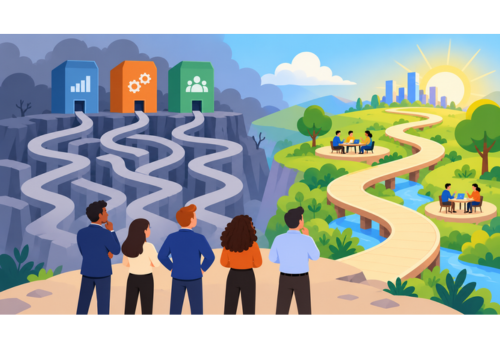
Have we designed organisations to be managed rather than to perform?
The more I thought about this, the more I found myself questioning something much more fundamental.
If we were setting up an organisation from scratch tomorrow, would we really organise it in the way we’ve typically done it?
So would we automatically create separate departments for L&D, operational excellence, organisational development and all the other functions we’ve got supporting us?
I’m not sure we would.
We would 100% need the expertise that sits within those disciplines, I’m convinced of that, but that’s not the same as saying we’d need the departments we’ve built around them. I’ve carried the belief for a while that we set things up in these ways so we can better manage them first and foremost. We’ve learned to group people with similar skills and expertise together because it makes it easier to allocate resources, establish reporting lines, develop professional standards and hold people accountable, and there are good reasons for doing that.
Over time though, I wonder whether we’ve started to confuse what’s convenient to manage with what’s actually best for the organisation. Just a thought.
The challenges organisations face these days are rarely straightforward and require greater flexibility. A problem with performance might involve leadership, processes, capability, technology and ways of working all at once. In most of my works it’s a combination of everything. Yet we’ve organised ourselves so that different functions are responsible for different parts of the picture, and then spend loads of time trying to get those functions to work together.
Sometimes it feels as though we’re trying to reconnect things we’ve already divided.
I think this reflects something about the way we’ve traditionally approached leadership and management. We’ve built organisations around hierarchies, divided responsibilities and created systems for directing and controlling work. We measure how well individual parts are performing and assume that if each part does its job effectively, the organisation as a whole should perform well. I arrive back at some of my systems thinking learning once again as organisations don’t necessarily work like that. What happens between teams and functions can be just as important as what happens within them.
The more I reflect on this, the more I wonder whether we are spending too much time trying to develop people to work differently without paying enough attention to the organisational conditions we’re asking them to work within.
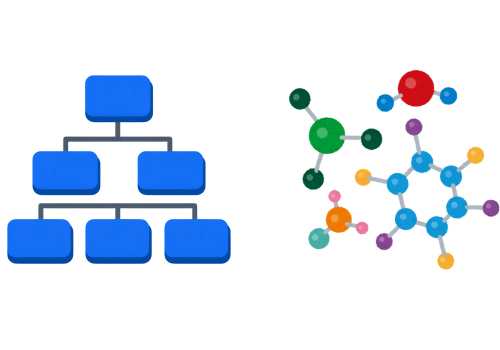
What if the organisation itself was the Adaptation Engine?
This brought me back to the idea of a learning organisation, something that has influenced my thinking for many years. Peter Senge is a good source of thinking for this.
Not an organisation where everyone attends more training, but one that’s continually capable of understanding its own performance, responding to changing circumstances and improving how it works. This would be an organisation where learning and improvement are part of everyday work rather than activities delivered by particular departments. I know most would say they either do this or strive for it but they rarely do in a serious way, let’s be honest.
I say that because for me, that requires a different approach to leadership. Rather than seeing their role primarily as directing and controlling activity, leaders would need to create the conditions for people to understand the wider organisation, work together around shared outcomes, make decisions and learn from what happens. The complete opposite of what could be termed command and control leadership.
There would still be a need for direction, accountability and specialist expertise, but maybe we’d think differently about how that expertise is organised and accessed, and who is responsible for improving performance. Instead of relying on particular functions to identify and deliver improvements, we’d build the ability to learn, adapt and improve into the way the organisation operates.
The more I think about it, the more this sounds like what the Adaptation Engine in the report is trying to describe. This is just my interpretation though. The difference is that I don’t see it as something L&D should necessarily become. I see it as something the whole organisation should be capable of being.
I’m not suggesting we should dismantle existing departments by the way or that there’s a simple alternative to inherited structures, but I do think it’s worth questioning some of the assumptions behind how we’ve chosen to organise them.
AI may be prompting L&D to rethink its future, and I found Eglė’s research a useful contribution to that conversation. For me though, the bigger opportunity is to look beyond any one function and ask whether the way we’ve designed our organisations is helping or hindering their ability to learn, adapt and improve.
Which leaves me with a question, which I always like to bring one at least…
If we were designing an organisation from scratch today, with the ambition of making it continually capable of learning, adapting and improving, would we build it the way we have?
And do we know what and how we would build? (now that’s a more interesting question)