

So, I heard this recently, “You’re going to have to really sell this to them.” A comment I have heard before a few times, but I can’t remember writing anything down around my thinking in relation to this so here goes.
The context behind this is as follows…..we’d (I was part of a small team) spent months working alongside people to redesign an end-to-end process that would fundamentally change the way they worked. The people doing the job had helped redesign it (a core principle in insist on when doing this type of work), we’d worked through different approaches, learnt from what worked and what didn’t, and we’d reached the point where we were preparing to introduce the new way of working more widely.
Before that happened, we brought the leadership team together as I wanted to ensure they understood their part.
So, we weren’t talking about the new process itself. We were talking about leadership. More specifically, we were exploring what behaviours leaders would need to demonstrate if this wasn’t going to become just another improvement project that gradually drifted back towards the old way of working.
That was the real purpose of the session as we already had a new process. What we were trying to create now was the environment where that process had the best chance of becoming the new normal.
That’s where this comment came from. One of the leaders said:
“You’re going to have to really sell this to them.”
I remember smiling to myself and thinking, errrrr, no… I’m definitely not going to be doing that.
Not because I wasn’t prepared to explain the new process or answer questions about it with people. More than happy (and capable) of doing that. But creating belief that this was the right direction for the organisation, isn’t something I could do.
Only the leaders could do that. I don’t work there. The majority of these people won’t have seen me before and won’t see me down the line.
So, we find ourselves thinking about what this actually means and the potential impact.
Great ideas are only the beginning
In a couple of weeks, I’ll be spending some time at the Northumbrian Innovation Festival. I went along last year and I would say it’s one of those events I genuinely enjoy because it brings together people who care about solving problems. Over a few days, people from different organisations and disciplines come together, challenge assumptions, experiment with ideas and often leave having created something that didn’t exist a week earlier. I’ll drop the details for this in the 2nd section of this newsletter.
It’s difficult not to be energised by all of this going on around you, and the food is great too.
But over the years I’ve realised that the thing I find most interesting isn’t actually the innovation itself, it’s what happens next. What happens when everyone returns to work, because that’s the point where the workshop ends and leadership begins. You could argue the leadership needs to be in the workshop too but let’s stick with this idea of it needing to prolong.
Ideas are exciting. They generate momentum and create optimism about what might be possible.
Making those ideas part of everyday practice is a very different challenge and one I have probably seen fail as much as I have land. Often this can be laid at the door of the external helper, even if it’s not on them.

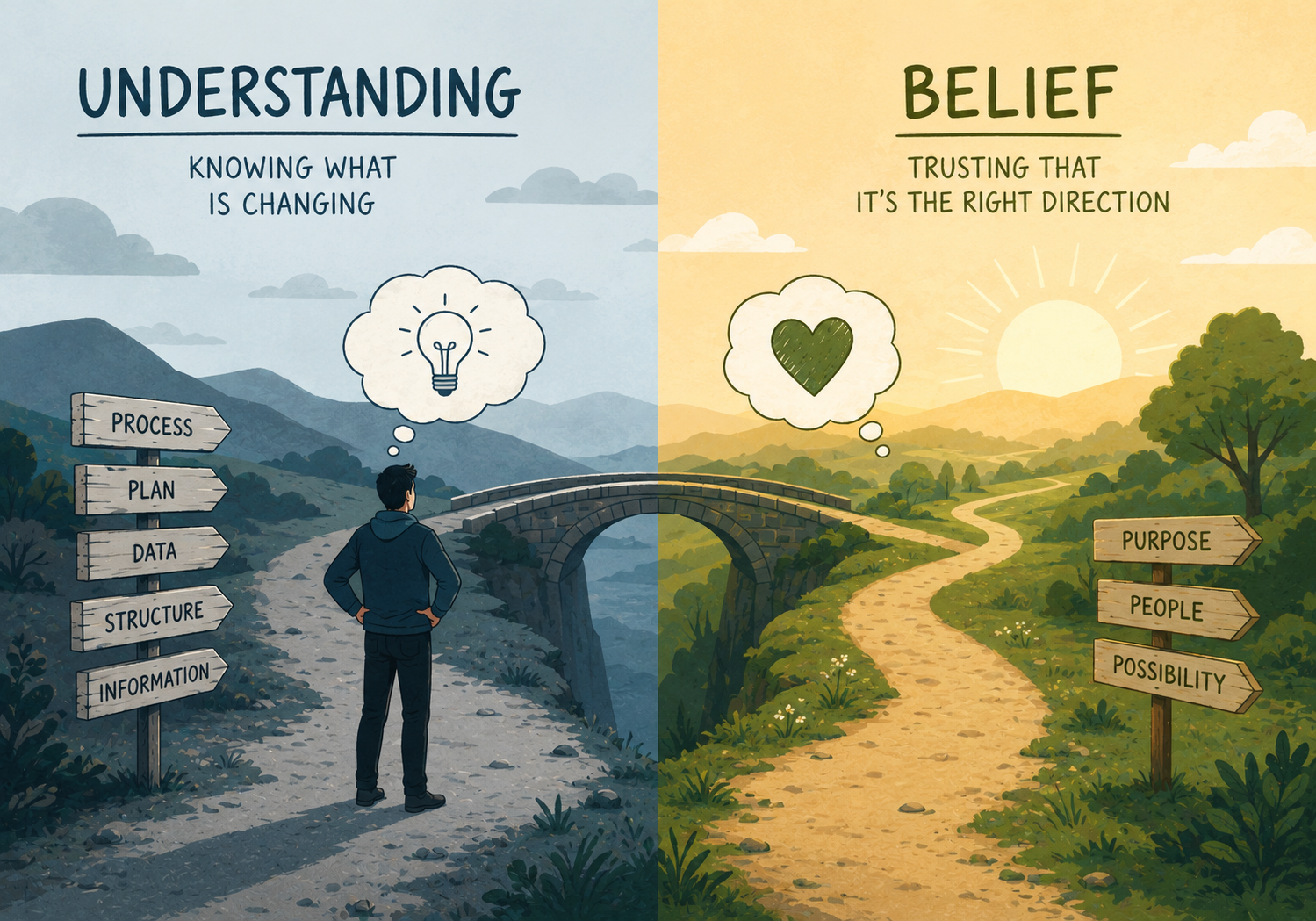
Understanding isn’t the same as believing
The more I’ve reflected on that conversation with the leadership team I mentioned, the more I’ve realised it exposed something I see all too often.
We sometimes assume that if people understand a change, they’ll naturally get behind it. I don’t believe that’s true at all.
Someone can understand exactly how a new process works and still quietly wonder whether it’s worth the effort and lack the desire to go with it. People can understand the rationale behind a new strategy while remaining unconvinced that it’ll survive the next priority call.
I’d even include AI in this in that they can understand why AI is being introduced into their organisation while still watching to see whether leadership genuinely believes it’s important.
Understanding answers the question of “What are we doing?”
Belief answers a different question such as “Is this really the direction we’re taking?”
The two are connected, but they’re not the same and missing this is critical really.
I’ve become increasingly convinced that organisations spend a great deal of time helping people understand change, but often underestimate the importance of helping people believe in it. Lots of communication in the mode of telling people information but not so much great communication when it comes to the subtle signals leaders give off every day (often blindspots).
The one thing leaders can’t outsource
One of the reasons I keep coming back to that conversation is because I don’t think the leader intended to hand over responsibility.
In lots of organisations, that’s simply how change has evolved.
This talks to my experience of this….
Project teams manage implementation.
Communications teams develop messaging.
Learning teams create training.
External partners bring expertise.
Now all of those things matter, of course they do, but the subtle risk is that somewhere along the way, leaders begin to assume that creating belief sits alongside those activities. They may not even consider that at all.
I don’t think belief exists in that stack by the way. People may listen carefully to a trainer and they might value the expertise of an external consultant, but when they’re deciding whether this change is genuinely going to shape the future of the organisation, they’re watching something else.
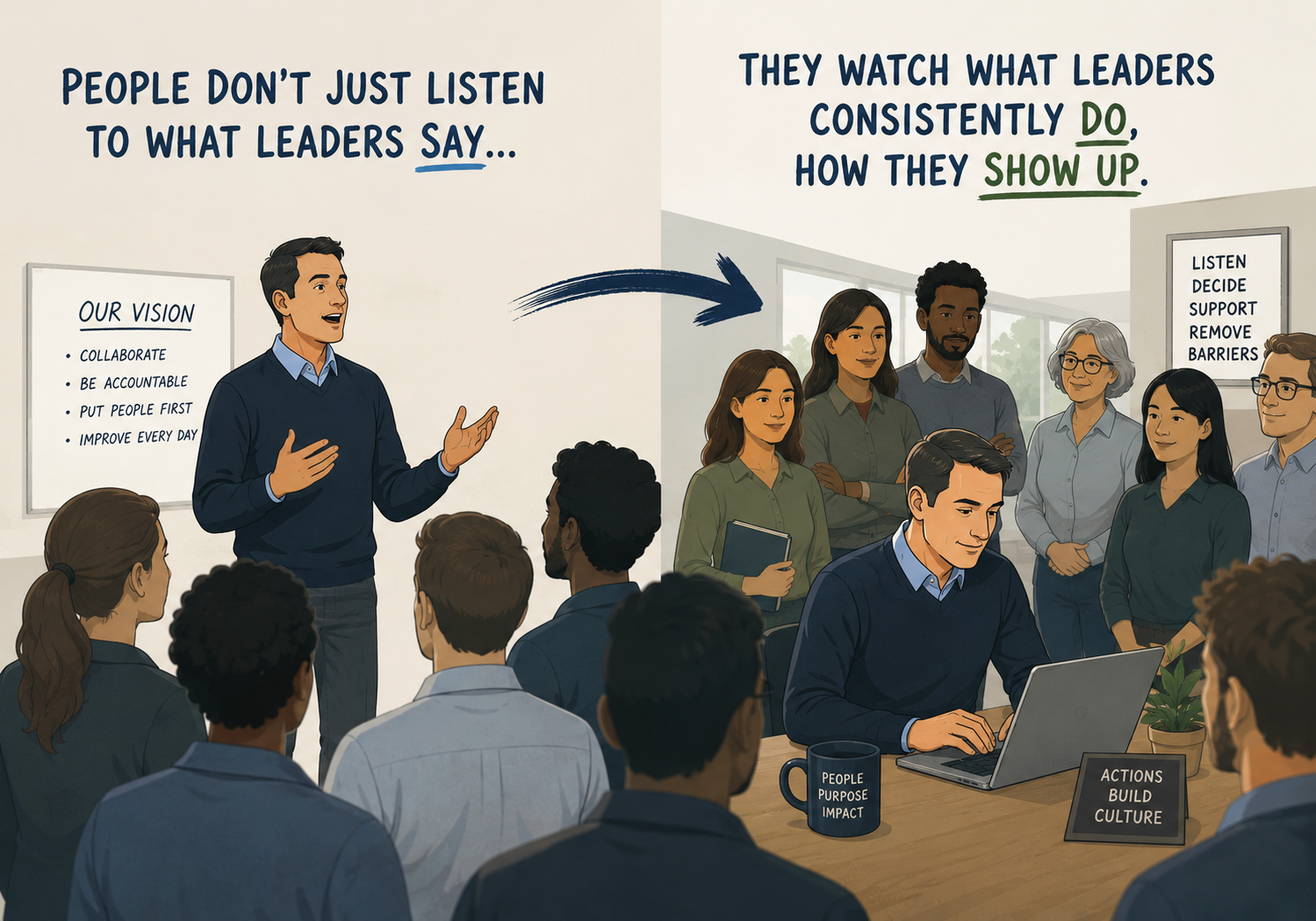
They’re watching their leaders, of course they are. Not just at specific times such as launch days, or workshops but at any given moment. They are picking up signals, verbal, non verbal. All of it.
They may have internal dialogue going whether conscious or subconscious such as…
Are they still talking about it?
Are they asking about progress?
Are they reinforcing the new behaviours?
Are they removing barriers when people encounter them?
How have they changes to support it?
Has their attention already shifted somewhere else?
As a leadership coach, one thing I’ve learnt is that leaders often underestimate just how closely people observe them. I think we all do this to an extent, it’s the same in home life if you have kids. Every conversation, every decision and every question sends a signal about what really matters.
People don’t just listen to what leaders say, they watch what leaders consistently do, how they show up.
Why this became one of our principles
Over the years we’ve developed six principles that guide how we help organisations deploy knowledge into practice. They were brought forward through working with an old friend and mentor of mine, Andrew Mclean. They aren’t intended to be another change framework. They’re simply observations drawn from experience about what seems to help change become sustainable.
One of those principles we call, Leadership Committed to the Path.
Over time working with this one principle, I’ve come to realise that this isn’t about leaders approving a project or attending a launch event. Committing to a path is much deeper than that.
It’s about remaining visibly committed after everyone else has moved on, continuing to ask about the change, to reinforce the behaviours and to create an environment where the new way of working has the best possible chance of succeeding.
Because if leaders quietly step away, people often come to the conclusion that they can too. For clarity, that isn’t on the individual at this point, its on the system they work within, of which any leader has a significant influence.

A few questions I’ve been asking myself
These are questions for any of us who lead change. So everyone in a leadership role essentially.
- When was the last time I spoke about this change outside of a formal update?
- Would my team know why it matters, or simply what they’re expected to do?
- How am I reinforcing the behaviours I want to see, or assuming someone else is doing that?
- If the project team disappeared tomorrow, would this change still have enough leadership behind it to succeed?
Honesty is required.
What’s the point in all of the resources you have deployed on this if it’s going to fall short because of your lack of positive impact in context?
Final Thoughts
There’ll be some brilliant ideas created at the Northumbrian Innovation Festival over the coming weeks as there always seems to be.
Hopefully, those ideas don’t simply leave the room as projects to be implemented, but as commitments that leaders are prepared to champion long after the workshops have finished. I can say I’ve worked with one individual who completely gets this and I see them taking action week on week. So there are some stories counter to the one I spent most of this thread around.
Let me leave you this to ponder on further.
Creating a better idea is only part of the challenge. Helping people understand the idea matters. Helping people believe in it matters even more, and that’s one of the few leadership responsibilities that can’t be delegated.
What are you currently attempting to delegate that can’t be delegated?