

I’ve being thinking about this balance a lot recently so decided to write something down around this. From what i see, many leadership teams struggle with the balance between support and challenge. I spend a fair chunk of time considering this when working in both group and individual settings.
Some environments become highly supportive but low in challenge. Difficult conversations are softened, accountability is delayed, and underperformance is tolerated for too long in the name of maintaining harmony.
Others go the opposite way. Expectations are high, pressure is constant, and challenge is everywhere, but support is missing. People can feel exposed rather than developed. Performance may improve in the short term, but trust and openness begin to erode underneath the surface.
Both approaches create problems.
The Gym Spotter Analogy
I like to go to the gym, sometimes with my other half, and we have a joke about ‘spotting’. Mainly because we don’t always fully observe it. You can think about support and challenge in this metaphor.
A good spotter in the gym has an important role. They provide support, confidence, and safety. They help you lift more than you could alone. But they don’t take the weight away. The moment the spotter lifts the entire bar for you, growth stops happening.
Leadership works in much the same way.
Many leaders genuinely care about their people, but sometimes that care unintentionally turns into protection from discomfort. Feedback becomes diluted and standards become negotiable. Challenge is avoided because of fear it may damage relationships.
The result is often a team that feels supported but slowly loses sharpness, accountability, and resilience.
When Challenge Exists Without Support
At the other extreme are leaders who believe pressure alone drives performance. I think most have worked under this leadership bias.
In spotting terms, the weight on the bar keeps increasing, but there is little attention paid to whether the person feels supported, prepared, or psychologically safe enough to grow through the challenge.
Eventually people may stop taking risks, stop speaking honestly, or simply disengage altogether.
High-performing teams definitely need both of these.
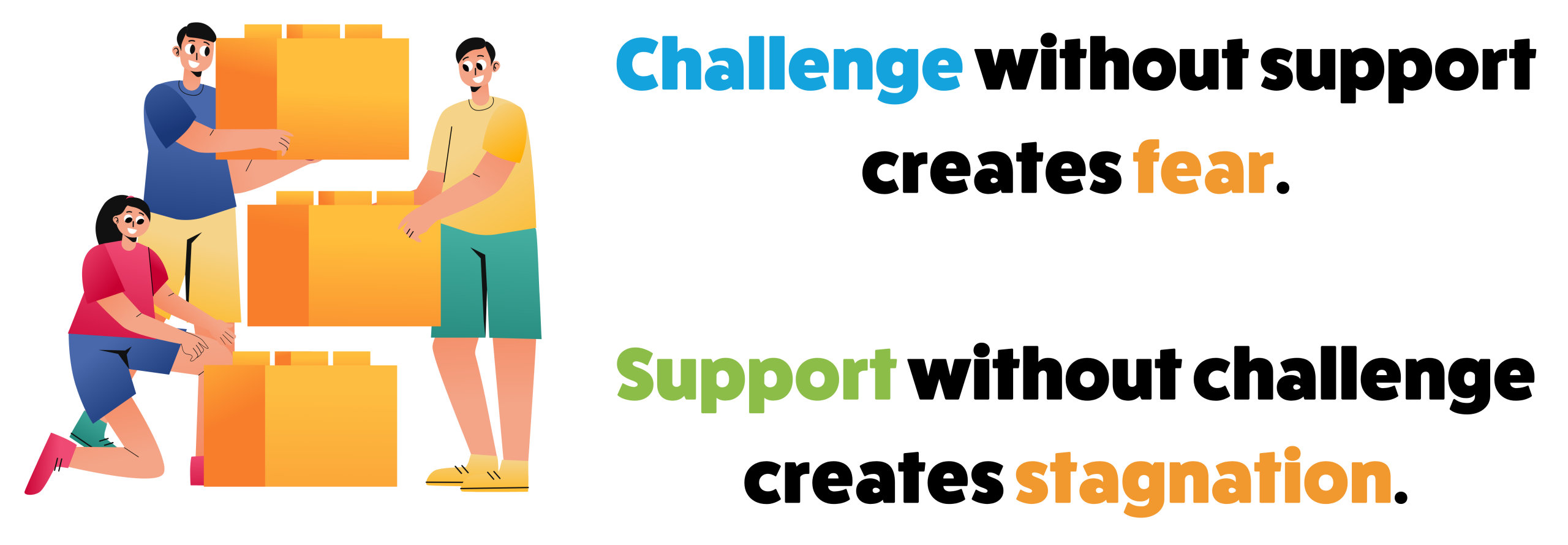
- Challenge without support creates fear.
- Support without challenge creates stagnation.
The healthiest leadership teams understand that growth requires productive tension between the two.
Where Leadership Values Come In
Most organisations proudly talk about values such as care, respect, accountability or excellence to name a few. But values become problematic when they are interpreted in isolation.
For example, I often see “respect” or “care” interpreted as avoiding difficult conversations, not upsetting someone. Leaders hold back feedback because they do not want to upset people or create discomfort. Over time, however, the absence of honest challenge can actually become disrespectful and not caring at all. People are denied the opportunity to grow, improve, or fully understand the impact they are having.
Equally, organisations that drive “high performance” or “excellence” can unintentionally create cultures where relentless challenge is normalised but support is neglected. Results may improve for a while, but exhaustion, defensiveness, and politics will increase alongside them. Targets are a good example of this where challenge is lodged against a number and so the game is set to make the number happen at all costs to avoid what feels like punishment.
Mature Leadership Requires Both
Mature leadership values require balance.
- Care shouldn’t remove accountability.
- Excellence shouldn’t remove humanity.
- Trust shouldn’t remove honest challenge.
In the strongest leadership teams I work with, challenge is not viewed as an attack. It is viewed as an opportunity to get better. Leaders challenge because they care about the person, the team, and the standards they are trying to uphold together.
Importantly, those teams also create enough safety for challenge to be received well. People know they will be supported through difficult conversations rather than judged or isolated by them.
The Leadership Questions That Matter
This balance is rarely achieved perfectly. Like adjusting the weight during training, leadership requires constant calibration. Of course it does it’s about human behaviour.
Different people, situations, and moments require different levels of stretch and support. What I would say though is that I believe the the key here is intentionality.
Too many leadership teams drift unconsciously toward one extreme or the other, often because they have never openly discussed the balance they are creating through their behaviours.
One of the simplest but most powerful conversations leadership teams can have is this:
- Where are we over-supporting and under-challenging?
- Where are we creating challenge without enough support?
Those two questions alone often reveal a lot about culture, trust, leadership maturity, and whether organisational values are being lived.
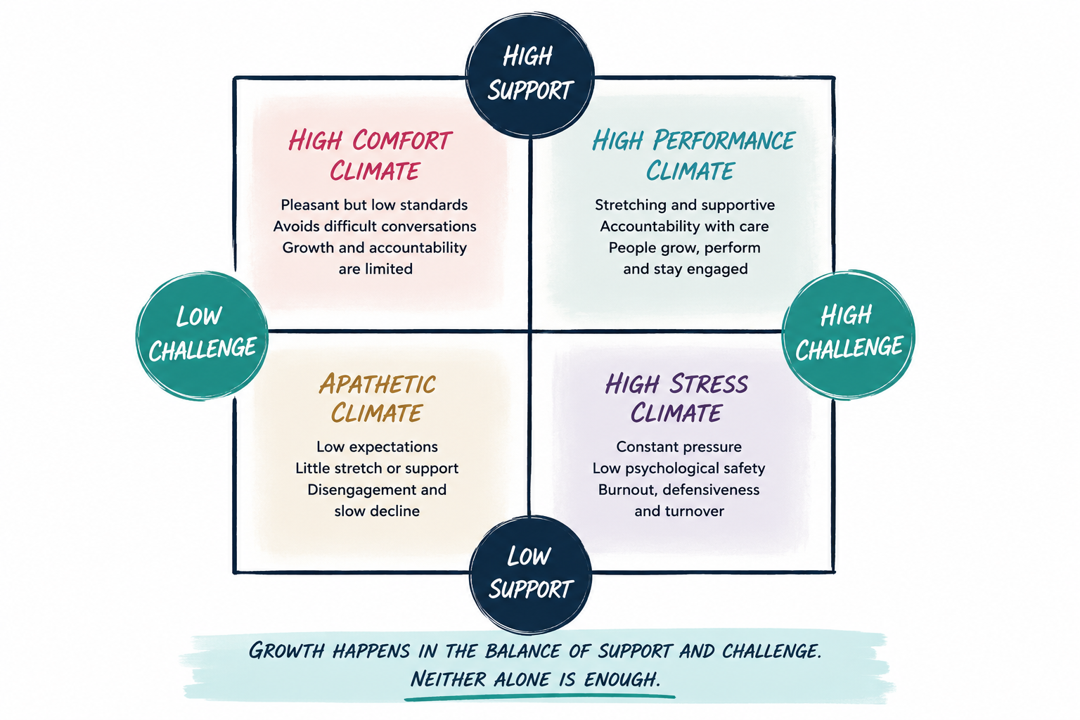
I use this model a fair bit (see image below) with leadership teams and so i thought this may be a useful resouce to bring in. Its common so you will no doubt have seen this before, but a refresh isn’t a bad idea.
Over time, leadership teams often drift toward one of four climates outlined.
A useful leadership conversation is simply this…
“Where are we currently operating as a team — and what might we need more of?”
Used well, this model can open up powerful discussions around leadership behaviours, accountability, trust, psychological safety, and whether organisational values are truly being lived in practice.
Final Thought
Ultimately, the real test of leadership values is not what is written on the wall or included in a presentation deck, but we all know that don’t we.
If we boil this down I believe you could say it is what happens in the moment someone needs to hear something difficult.
In both leadership and training in the gym, growth rarely comes from removing the weight altogether. It comes from knowing people are supported enough to carry more than they thought they could in the first place.