

This past week, I received an email from a former client I had worked with on a leadership development programme for a group of relatively young managers.
The opening line popped up in my inbox and read…
“Your influence is enduring…”
I’ll be honest, I thought they had forwarded me something, a leadership article or something like that, until I opened it and realised it wasn’t.
It is always nice to hear something like this, anyone that says they don’t like to hear things like that I’m not sure I would believe them, but it was what followed that really made me think on this and write this down.
Two years after we had worked together, two of the managers who had been through the programme were bringing some of it back to life. They had started working with their current team, revisiting ideas around high-performing teams and trust as examples.
But they weren’t simply rerunning what we’d done two years earlier.
It appears they were adapting and reframing it. Involving their people in deciding what it needed to look like now and making the frameworks relevant to the team they have today.
I felt really proud of them, and if I’m being truthful, proud of the work we’d done together too.
But it also reminded me of something I’ve believed for quite a long time about leadership and development that Sometimes all you can do is plant the seeds.
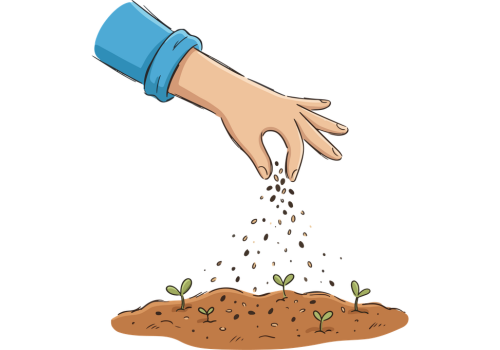
Learning doesn’t always happen when teaching happens
We understandably want development activity to have an impact. We tend to invest time and money in programmes, coaching, workshops and conversations, and then want to know what has changed. What are people doing differently? What have they implemented? What results can we point towards?
There is nothing wrong with asking those questions, but I wonder whether we sometimes expect learning to follow a more clear laid out path than it actually does.
Someone can sit in a leadership session, understand an idea perfectly well and genuinely intend to use it, but perhaps they haven’t yet experienced the situation that gives that idea real meaning.
Then six months, a year or even two years later, something happens. Let’s say they inherit a difficult team, that they have to navigate conflict or been that someone challenges their leadership. Suddenly out of the blue an idea might pop into their head, that links to something from two years ago that’s now become useful.
The learning hasn’t necessarily just happened, it’s just that the experience has finally given the learning somewhere to land.
It makes me wonder: how quickly we expect to see evidence that development has worked? And what might get dismissed too early just because the seed hasn’t broken through the surface yet?

The aim shouldn’t be to create copies
The managers involved weren’t treating the material as something precious that had to be preserved exactly as I had originally introduced it. They were asking what their team needed now and adapting the thinking accordingly.
Surely that is what we should want?
If someone leaves a leadership programme able to repeat the models, language and frameworks they were taught, they may have learned something. But if, two years later, they can decide what is useful, adapt it to a different context and use it to help other people develop, something deeper has happened. You could say they’ve developed judgement.
There is a temptation in leadership development, and perhaps leadership more broadly, to measure our impact by how closely people continue to do things the way we showed them.
Maybe a better measure is whether they eventually don’t need us at all.
When you develop other people, are you unconsciously looking for replication, or are you creating enough space for them to take what you’ve given them and make it their own?

You don’t get to decide which seeds grow
The metaphor of planting seeds has been with me for years and I’ve used it to help others handle frustrations, especially in improvement work. The reality is you don’t control what happens next.
As leaders, coaches or anyone involved in developing people, we can introduce an idea, ask a question, challenge someone’s thinking or even say something that changes how they see a situation. But none of that guarantees what they will do with it.
Some ideas will drop in immediately whilst others will sit there for a long time. Some will disappear completely and even more interesting is that we don’t always know which is which.
I’ve had conversations that felt significant at the time and have no idea whether they made any lasting difference. Equally, people have occasionally reminded me of something I said years ago that I can barely remember saying, but which stayed with them.
Maybe a part of developing others is becoming comfortable with a level of uncertainty around any of this.
I believe our responsibility is to create the conditions, offer the challenge, share what might be useful and help people think. Their responsibility is what happens next, that’s not on us.
What seeds are you planting through the conversations you’re having with people now? And are you comfortable with the possibility that you may never see what grows from them?
Influence doesn’t end when you leave the room
So, back to the idea in that opening line.
We tend to think about leadership impact through what we can see around us don’t we. This could be the performance of our current team, the decisions being made, the culture we’re creating, the results being achieved. But if this is anything to go by then some of our influence exists somewhere else.
An example could be in the manager who handles a difficult conversation differently because of something they learned from us three years ago. Another could be the person who gives someone else an opportunity because we once gave them one.
We will probably never even know this is happening and there is something quite humbling about that, but also something important. Also I do realise there may be a slight irony in my own example here in that i’ve shared this with people and it may not appear that humble, but my reason is for 100% for learning purposes.
Not all leadership work produces an immediate, visible return. Some of it is dine in the quiet, through conversations, questions, encouragement, challenge and ideas that we might never see come to fruition.
In my eyes this doesn’t make the work less valuable it just makes the seeds that we choose to plant more important.
So, if some of your influence will only become visible long after you’ve left the room, what are you planting today that you would be happy to see growing two years from now?